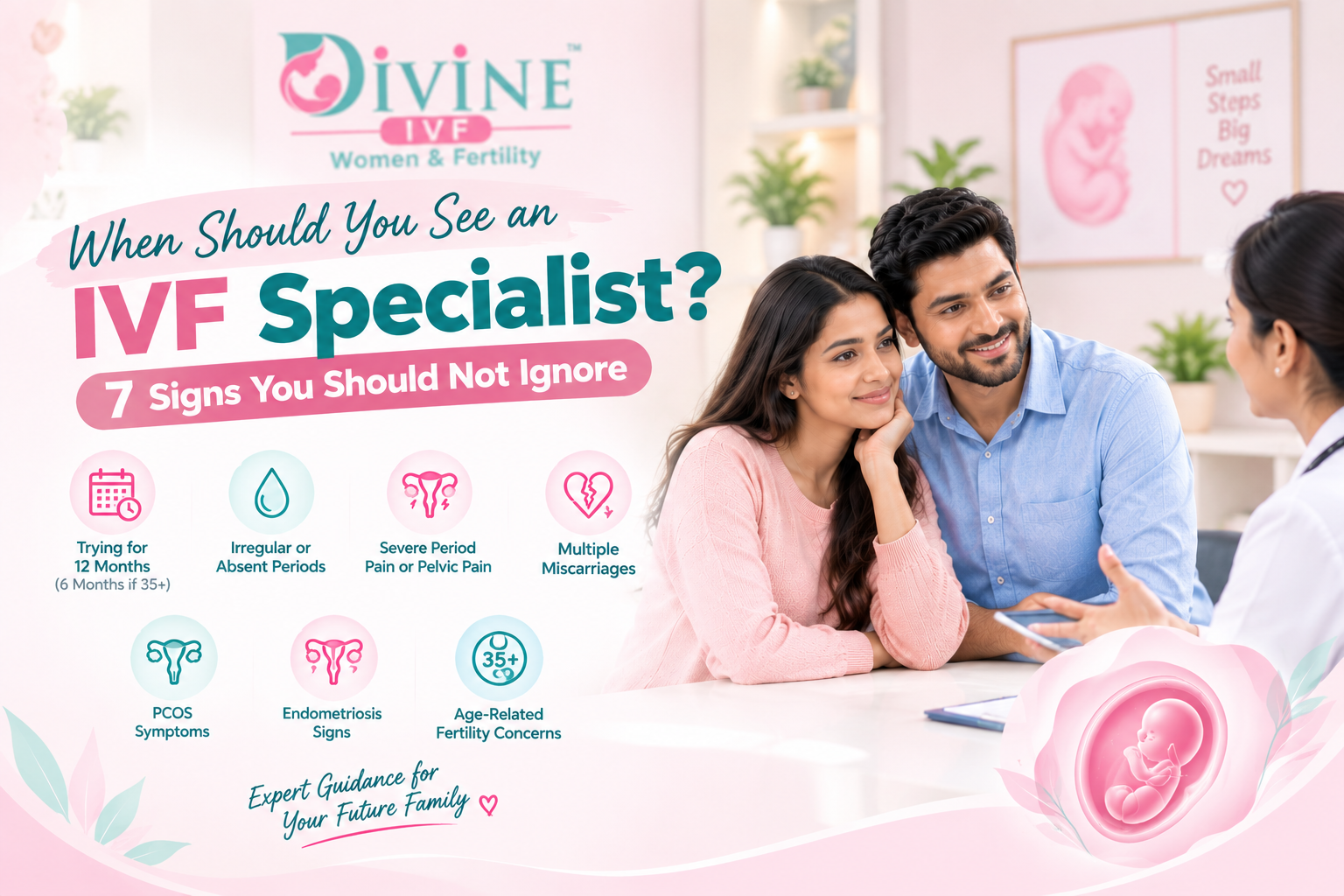
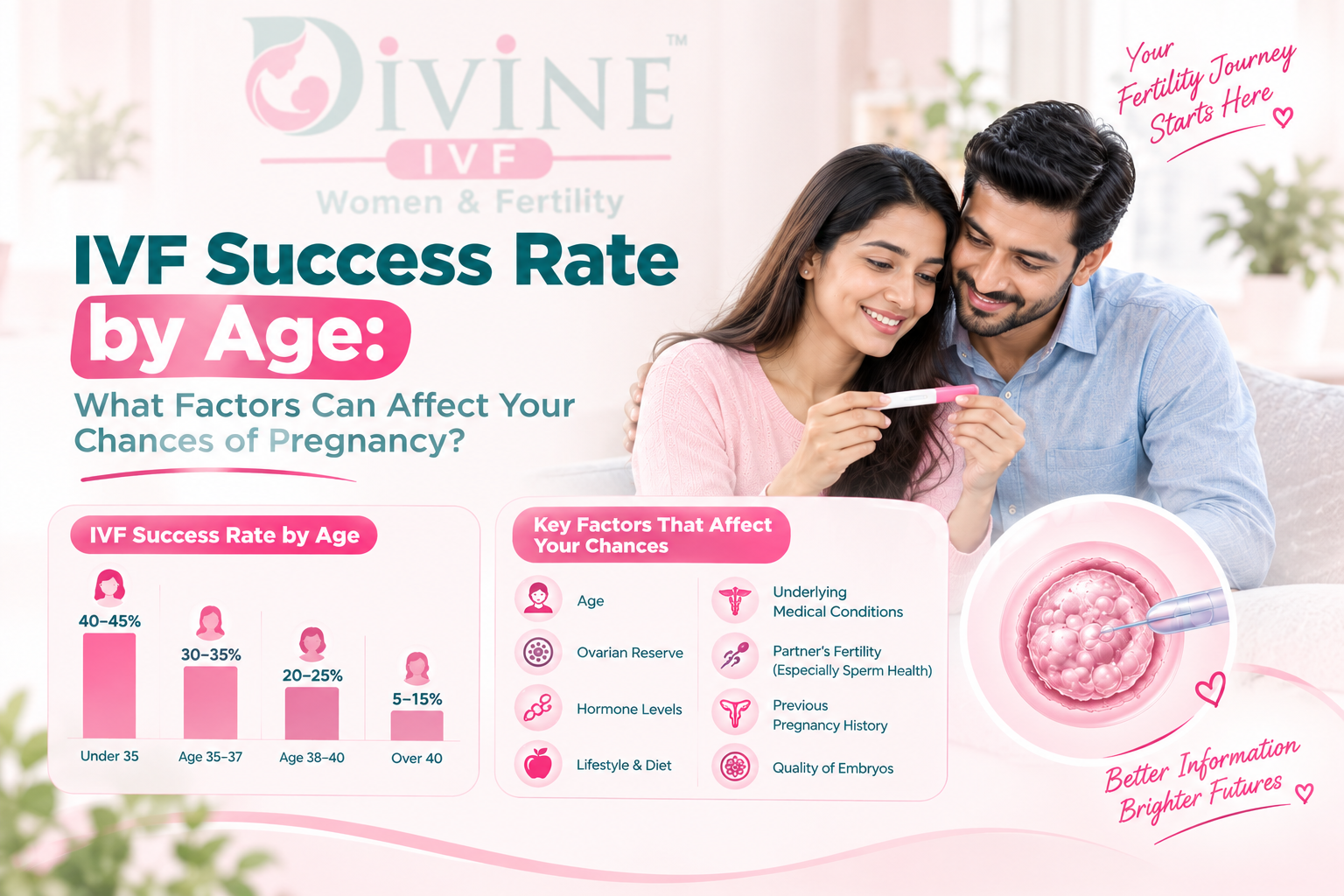
IVF Success Rate by Age: What Factors Can Affect Your Chances of Pregnancy?
Introduction: Understanding Your IVF Journey
If you're reading this, chances are you've been asking yourself one question: What are my real chances of having a baby through IVF?
It's a question that deserves an honest answer. The truth is, IVF success rates vary significantly depending on several factors — and age sits at the very top of that list. But here's what many people don't realize: age is not the only factor that matters. How your body responds to treatment, the quality of care you receive, and the personalized approach your fertility specialist takes all play a meaningful role.
At Divine IVF in Sector 76, Noida, Dr. Mandavi Rai has guided over 3,000 families through their parenthood journeys. With 15+ years of experience and a fellowship in Reproductive Medicine from NUS Singapore, she brings both clinical expertise and genuine empathy to every consultation.
Let's break down what the data actually says about IVF success by age — and more importantly, what it means for you.
IVF Success Rates by Age: What the Data Shows
Age is the single most significant predictor of IVF outcomes. This isn't meant to alarm you — it's meant to empower you with knowledge so you can make informed decisions.
Here's how IVF success rates generally look across age groups:
Under 30: The Most Favorable Outcomes
Women under 30 typically see the highest success rates, with some well-equipped clinics reporting success rates exceeding 78% at Divine IVF. At this age, egg quality and quantity are at their peak, and the uterus is generally at its most receptive.
Age 30–35: Still Strong, Slight Decline
Success rates remain encouraging, typically ranging from 40–50% per embryo transfer in well-equipped centres. Many women in this bracket still have good ovarian reserve and healthy eggs.
Age 35–40: A More Noticeable Shift
This is when things begin to change. Live birth rates typically fall to 20–30% per transfer. Egg quality starts to decline more rapidly, and chromosomal abnormalities become more common.
Age 40–43: Lower Per-Cycle Success
Per-cycle success rates drop significantly, often to 10–20%. Many women in this age group benefit from additional technologies like genetic testing or donor eggs.
Over 43: Challenging but Not Impossible
Using a woman's own eggs, live birth rates often fall below 5–10% per transfer. However, donor egg IVF can dramatically improve outcomes for this age group.
Important context: These are per-cycle figures. Cumulative success rates — your chances across multiple IVF cycles — are significantly higher, especially for women under 40.
The Biology Behind Age-Related IVF Decline
Why does age affect IVF outcomes so profoundly? Understanding the biology can help you have more realistic and productive conversations with your fertility specialist.
Egg Quality Declines with Age
Women are born with all the eggs they'll ever have. As those eggs age, they accumulate chromosomal errors that can prevent fertilization, stop embryo development, or lead to miscarriage. Women over 40 face a 3–6 times higher miscarriage risk due to chromosomal abnormalities.
Ovarian Reserve Diminishes
The number of available eggs decreases over time. This is measured by AMH (Anti-Müllerian Hormone) levels, which indicate ovarian reserve but not egg quality. A low AMH doesn't guarantee failure, and a normal AMH doesn't guarantee success.
The Uterine Environment Matters Too
Recent research has revealed something important: the uterus itself ages. A study presented at the ESHRE 2026 Annual Meeting found that even when using donor eggs from younger women, live birth rates declined for recipients over 49, suggesting age-related changes in the uterine environment. The proportion of women with a receptive endometrial pattern decreased from 94.7% (ages 35–40) to 81% (age 49+).
Beyond Age: Other Factors That Affect IVF Success
Age matters. But it's not the whole story. Several other factors can significantly influence your IVF outcomes.
Embryo Quality
The quality of embryos transferred is a critical determinant of success. High-quality blastocysts — embryos cultured to day 5 or 6 — significantly improve pregnancy rates. At Divine IVF, advanced laboratory techniques help identify the most viable embryos for transfer.
Embryo Transfer Stage
Research consistently shows that blastocyst transfer (day 5–6) yields higher pregnancy rates than cleavage-stage embryo transfer (day 3). Extended culture allows poor-quality embryos to naturally arrest, leaving the strongest candidates for transfer.
Single vs. Multiple Embryo Transfer
For patients under 35 with good prognosis, transferring one high-quality blastocyst achieves an ideal pregnancy rate while significantly reducing multiple pregnancy risks. This is an important consideration for both safety and success.
Male Fertility Factors
Fertility is a two-person equation. Paternal age, sperm quality, and DNA fragmentation all influence fertilization rates and embryo development. That's why Divine IVF evaluates both partners together — it's the only way to get the complete picture.
Underlying Fertility Diagnosis
The cause of infertility plays a role in how treatment is tailored. Conditions like PCOS, endometriosis, tubal factor infertility, or male factor infertility each require different clinical approaches.
Lifestyle and General Health
Factors like BMI, smoking, stress, and underlying medical conditions can affect IVF outcomes. Your fertility team should consider your overall health, not just your reproductive system.
What Does This Mean for Your IVF Journey?
Here's what we want you to take away from all this data:
Age matters — but your individual circumstances matter more than statistics alone.
Success rates are averages. They don't tell you what will happen in your specific case. A 42-year-old with good ovarian reserve and high-quality embryos may have better odds than a 38-year-old with diminished reserve.
Cumulative success is higher than single-cycle success.
Most patients don't succeed on their first attempt. Planning for multiple cycles is realistic and often necessary, especially for women over 35.
The right clinic and protocol make a difference.
Personalized protocols, advanced lab techniques, and experienced clinical judgment can meaningfully improve outcomes. At Divine IVF, every treatment plan is shaped directly by Dr. Mandavi Rai — not a rotating team.
How Divine IVF Approaches Fertility Care
Dr. Mandavi Rai's approach is built on years of experience treating diverse fertility journeys. Her philosophy is simple but powerful: treat the person, not just the diagnosis.
At Divine IVF, the approach includes:
- Individualized evaluation tailored to your history
- Comprehensive fertility assessment for both partners
- Advanced reproductive options from IUI to ICSI, PICSI, IMSI, and genetic testing
- Clear communication at every step — explained in plain language, with room for your questions
With over 3,000 parenthood journeys and a 4.8-star rating from 500+ patients, Divine IVF has become a trusted destination for fertility care in Noida.
When to Consider Donor Eggs
For women over 40, donor egg IVF can be a game-changer. Using eggs from a donor typically under 35, success rates reflect the donor's egg quality rather than the recipient's age.
Research shows donor egg success rates per transfer reach 43–52% for recipients aged 40–44, compared to just 8–12% using their own eggs. For recipients aged 45–49, rates remain around 38–48%.
This is a deeply personal decision. The right time to consider donor eggs is when you and your fertility specialist have thoroughly discussed your options and your individual prognosis.
FAQ Section
What is the IVF success rate for a 35-year-old woman?
For women aged 35–37, live birth rates typically range from 30–40% per embryo transfer in well-equipped fertility centres. However, individual results vary based on egg quality, ovarian reserve, and other personal factors.
Does IVF success rate decrease with age?
Yes. Age is the single most important predictor of IVF outcomes. Success rates gradually decline through the 30s, drop more noticeably after 37, and decline further after 40.
Can I get pregnant with IVF at 43?
It's possible, but challenging with your own eggs. Live birth rates for women over 43 using their own eggs are typically below 5–10% per transfer. Donor egg IVF offers significantly higher success rates for this age group.
What factors besides age affect IVF success?
Key factors include embryo quality, the stage at which embryos are transferred (blastocyst vs. cleavage stage), male fertility factors, underlying fertility diagnosis, and lifestyle factors like BMI and smoking.
Are IVF success rates higher with frozen or fresh embryo transfer?
Both approaches can be successful. The choice between fresh and frozen transfer depends on your specific cycle characteristics. Research indicates that transferring a single high-quality blastocyst — whether fresh or frozen — can achieve ideal pregnancy rates while reducing multiple pregnancy risks.
How many IVF cycles might I need?
Many women over 35 need 2–3 cycles or more to achieve a live birth. Cumulative success rates across multiple cycles are meaningfully higher than single-cycle rates. Your fertility specialist can help you plan a realistic treatment pathway.
Ready to Take the Next Step?
Your dream of parenthood deserves a clear, personalized plan — not just statistics.
At Divine IVF, Sector 76, Noida, Dr. Mandavi Rai and her team are ready to listen to your story, answer your questions, and guide you toward the best possible outcome for your unique situation.
Book your consultation today and start your journey with the care and expertise you deserve.