When Should You See an IVF Specialist? 7 Signs You Should Not Ignore
Introduction
Every month that passes while trying to conceive can feel like an eternity. The questions pile up. The uncertainty grows. And somewhere in the back of your mind, a voice whispers: Is it time to see someone?
The truth is, many couples wait far too long before seeking help. They convince themselves that "it will happen naturally" or that "we just need more time." But when it comes to fertility, timing matters more than most people realise.
Your fertility potential changes with every passing year. The decisions you make today can shape the options available to you tomorrow. This is not meant to create panic. It is simply the biological reality that every fertility specialist wishes more couples understood earlier.
At Divine IVF, Dr. Mandavi Rai has spent over 15 years helping individuals and couples navigate this exact crossroads. With 10 years of focused experience in infertility and reproductive medicine, she has seen how early guidance can transform outcomes.
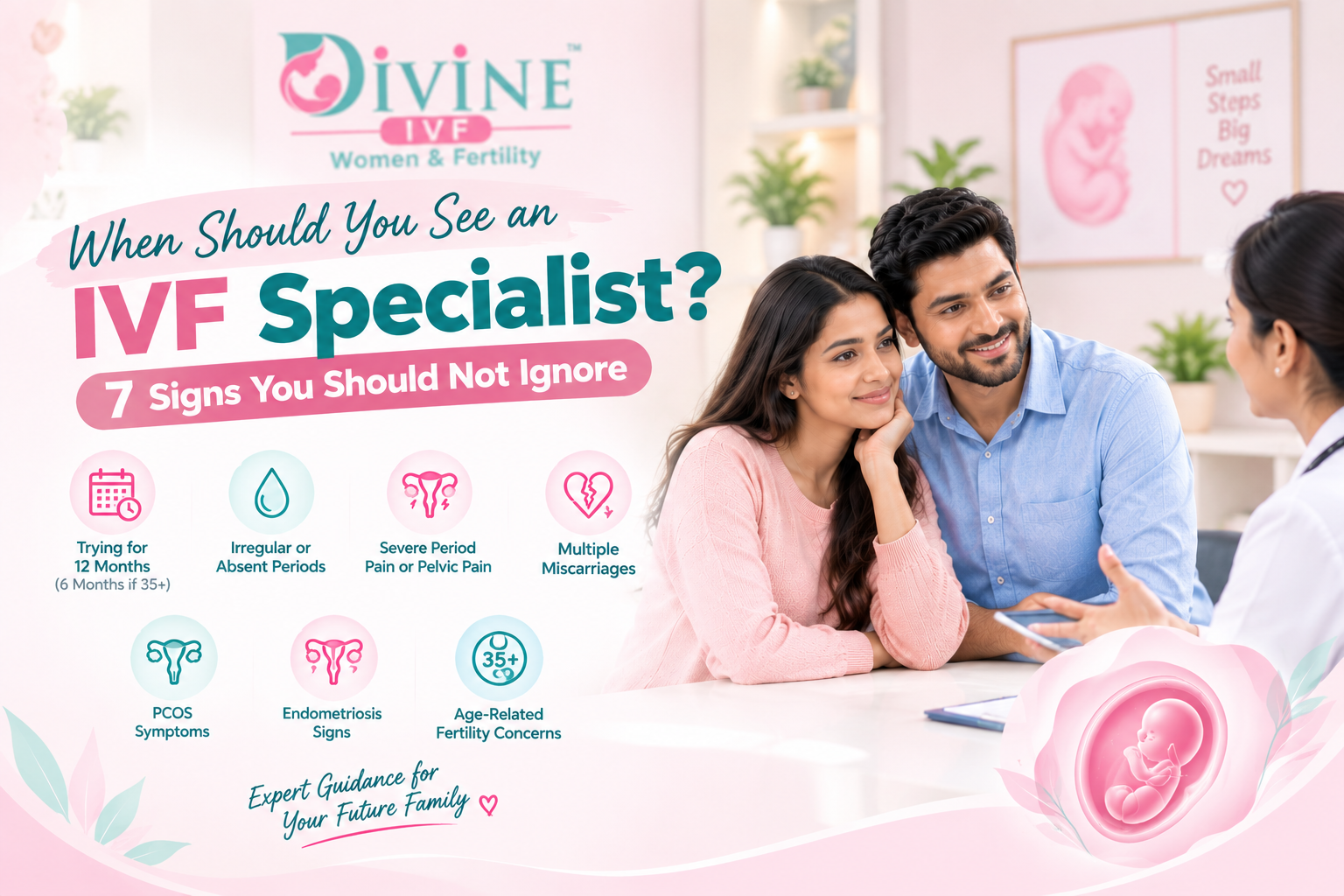
Below are the 7 signs that should prompt you to consult an IVF specialist. If any of these resonate with you, please do not wait.
1. You Have Been Trying for 12 Months (Or 6 Months If You Are Over 35)
This is the most straightforward sign, yet it is the one most commonly ignored.
The standard guideline:
- Under 35 years: Try naturally for 12 months before seeking evaluation
- 35 years and older: See a specialist after 6 months of trying
- Over 40 years: Consult immediately when you decide to try for pregnancy
Why the difference? Because female fertility does not decline in a straight line. It accelerates after 35. Egg quantity decreases. Egg quality declines. The likelihood of chromosomal abnormalities in eggs rises.
Consider the numbers: If you are 30, each month of trying naturally gives you roughly a 1 in 5 chance of conceiving. By 40, that drops to less than 1 in 20. That is not a reason to despair. It is a reason to plan.
The sooner you have accurate information about your ovarian reserve, hormone levels, and overall fertility profile, the sooner you can make informed choices. Waiting twelve months when you are 38 is not patience. It is lost time.
2. Your Menstrual Cycles Are Irregular or Absent
A regular menstrual cycle is a sign that your body is ovulating. When cycles become unpredictable, infrequent, or stop altogether, it is a clear signal that something in the reproductive system needs attention.
What counts as irregular?
- Cycles shorter than 21 days or longer than 35 days
- Cycles that vary significantly from month to month
- Missing periods for three or more consecutive months (without pregnancy)
Irregular cycles often point to ovulation disorders. The most common underlying cause is Polycystic Ovary Syndrome (PCOS), a hormonal condition that affects how the ovaries function. Other potential causes include thyroid dysfunction, elevated prolactin levels, or diminished ovarian reserve.
The mistake many couples make is assuming that irregular periods are "just how my body is." If you are not ovulating regularly, no amount of waiting will change that. Ovulation induction medications, lifestyle modifications, or targeted fertility treatments can address the root cause. But you cannot treat what you have not diagnosed.
3. You Experience Severe Period Pain or Pelvic Pain
Mild cramping during menstruation is normal. Pain that stops you from working, studying, or functioning is not.
Severe menstrual pain (dysmenorrhoea) that does not respond to standard pain relief may indicate endometriosis — a condition where tissue similar to the uterine lining grows outside the uterus. Endometriosis affects an estimated 1 in 10 women of reproductive age. Among women with infertility, the prevalence is even higher.
Endometriosis can:
- Cause scar tissue and adhesions that block fallopian tubes
- Damage egg quality
- Reduce ovarian reserve
- Create chronic inflammation that interferes with implantation
Other warning signs include:
- Pain during intercourse (dyspareunia)
- Painful bowel movements or urination during periods
- Chronic pelvic pain that persists outside of menstruation
If you have been managing severe period pain with heat packs and hope, please stop. This is not something you need to endure. More importantly, the longer endometriosis remains untreated, the more damage it can cause to your fertility.
4. You Have Had Multiple Miscarriages
A single miscarriage, while heartbreaking, does not necessarily indicate a fertility problem. Many women who experience one miscarriage go on to have healthy pregnancies.
Recurrent miscarriage is defined as two or more consecutive pregnancy losses. When this happens, the reasons need to be investigated.
Possible causes include:
- Chromosomal abnormalities in the embryo
- Uterine abnormalities (fibroids, polyps, septate uterus)
- Blood clotting disorders
- Thyroid or hormonal imbalances
- Immunological factors
A fertility specialist can perform a recurrent miscarriage evaluation to identify the underlying cause. This may include genetic testing, imaging of the uterus, and blood tests for clotting and autoimmune conditions.
The emotional toll of repeated miscarriage is immense. But there is another cost — time. Each loss delays the possibility of a successful pregnancy. If you have experienced two or more miscarriages, please seek specialised care.
5. You Have a Known Fertility-Related Diagnosis
Sometimes the answer is already in your medical history. If you have been diagnosed with any of the following conditions, seeing a fertility specialist is not optional — it is essential:
Female factors:
- Blocked fallopian tubes: Often silent, sometimes causing mild pelvic pain or unusual discharge. Blocked tubes prevent the egg and sperm from meeting.
- Diminished ovarian reserve (DOR): Fewer eggs than expected for your age. Most women with DOR have no symptoms until they try to conceive.
- Endometriosis: Beyond pain, this condition can damage reproductive organs.
- Uterine fibroids or polyps: These can interfere with implantation.
- Previous pelvic surgery or infection: Scarring can affect fertility.
Male factors:
- Low sperm count or motility
- Varicocele (enlarged veins in the scrotum)
- Previous testicular surgery or cancer treatment
- Azoospermia (no sperm in the ejaculate)
Here is something worth stating clearly: Male factor infertility contributes to approximately 40-50% of infertility cases. Too often, the focus is entirely on the woman. A proper fertility evaluation must include both partners.
6. You Have Been Diagnosed with PCOS or Endometriosis
These two conditions deserve their own mention because they are so commonly misunderstood.
PCOS is not just a fertility issue. It is a metabolic and hormonal condition that affects multiple systems in the body. Women with PCOS often have irregular ovulation, insulin resistance, and elevated androgen levels. While many women with PCOS can conceive naturally, some require ovulation induction medications, IUI, or IVF.
Endometriosis is more than painful periods. Research shows that 25% to 50% of women with infertility have endometriosis. The condition can affect egg quality, tubal function, and the uterine environment. Even "mild" endometriosis can significantly impact fertility.
If you carry either of these diagnoses, do not wait to see what happens. These are not conditions that simply resolve on their own. They require proactive management and, often, a personalised fertility treatment plan.
7. You Are a Woman Over 35 and Concerned About Your Fertility
This sign is different from the first one. It is not about how long you have been trying. It is about a nagging concern that has not left you.
Maybe you have not started trying yet. Maybe you are not sure if you want children right now. But you feel the weight of your age and wonder what your options are.
This is a valid reason to see a fertility specialist.
Fertility preservation is not just for cancer patients or women freezing eggs before a career break. It is for any woman who wants to understand her ovarian reserve, learn about her options, and make decisions with accurate information rather than fear.
A simple AMH blood test and an antral follicle count ultrasound can provide a clear picture of how many eggs you have remaining. This information can be liberating. It can tell you that you have time. Or it can tell you that waiting another three years carries real risk.
Either way, you deserve to know.
Why an IVF Specialist — Not Just a Gynaecologist?
This is a question worth addressing directly.
A gynaecologist is trained to manage women's health across the lifespan — menstruation, pregnancy, menopause, infections, and general reproductive conditions. Many gynaecologists provide basic fertility care, such as ovulation medication.
An IVF specialist or fertility specialist has additional, focused training in reproductive endocrinology and infertility. They are trained specifically to:
- Diagnose the underlying cause of infertility in both partners
- Interpret specialised fertility tests (AMH, FSH, semen analysis, HSG)
- Manage complex conditions like recurrent IVF failure and diminished ovarian reserve
- Perform advanced assisted reproductive procedures (IVF, ICSI, PICSI, IMSI)
- Make nuanced clinical decisions about stimulation protocols and embryo transfer timing
When basic treatments have failed, or when the cause of infertility is unclear, an IVF specialist offers a level of expertise that a general gynaecologist may not possess.
What Happens When You Consult an IVF Specialist?
Many couples delay consultation because they fear it will be a sales pitch for IVF. It is not.
A proper fertility consultation involves:
1. Detailed History
Your menstrual history, previous pregnancies, surgeries, medications, and lifestyle factors. Your partner's history is equally important.
2. Fertility Assessment
For women: hormone blood tests (FSH, LH, AMH, thyroid, prolactin), ultrasound to assess ovarian reserve and uterine health. For men: semen analysis.
3. Diagnosis and Discussion
The specialist explains what the tests reveal and what they mean. Not every diagnosis leads to IVF. Some couples need only ovulation induction. Others may benefit from IUI. IVF is one option among several.
4. Individualised Plan
Treatment should be tailored to your specific situation — your age, diagnosis, ovarian reserve, and personal preferences. At Divine IVF, Dr. Mandavi Rai emphasises that no two fertility journeys are the same. The plan you receive should reflect that.
The Cost of Waiting
It is worth stating plainly: fertility treatment works best when it is not delayed.
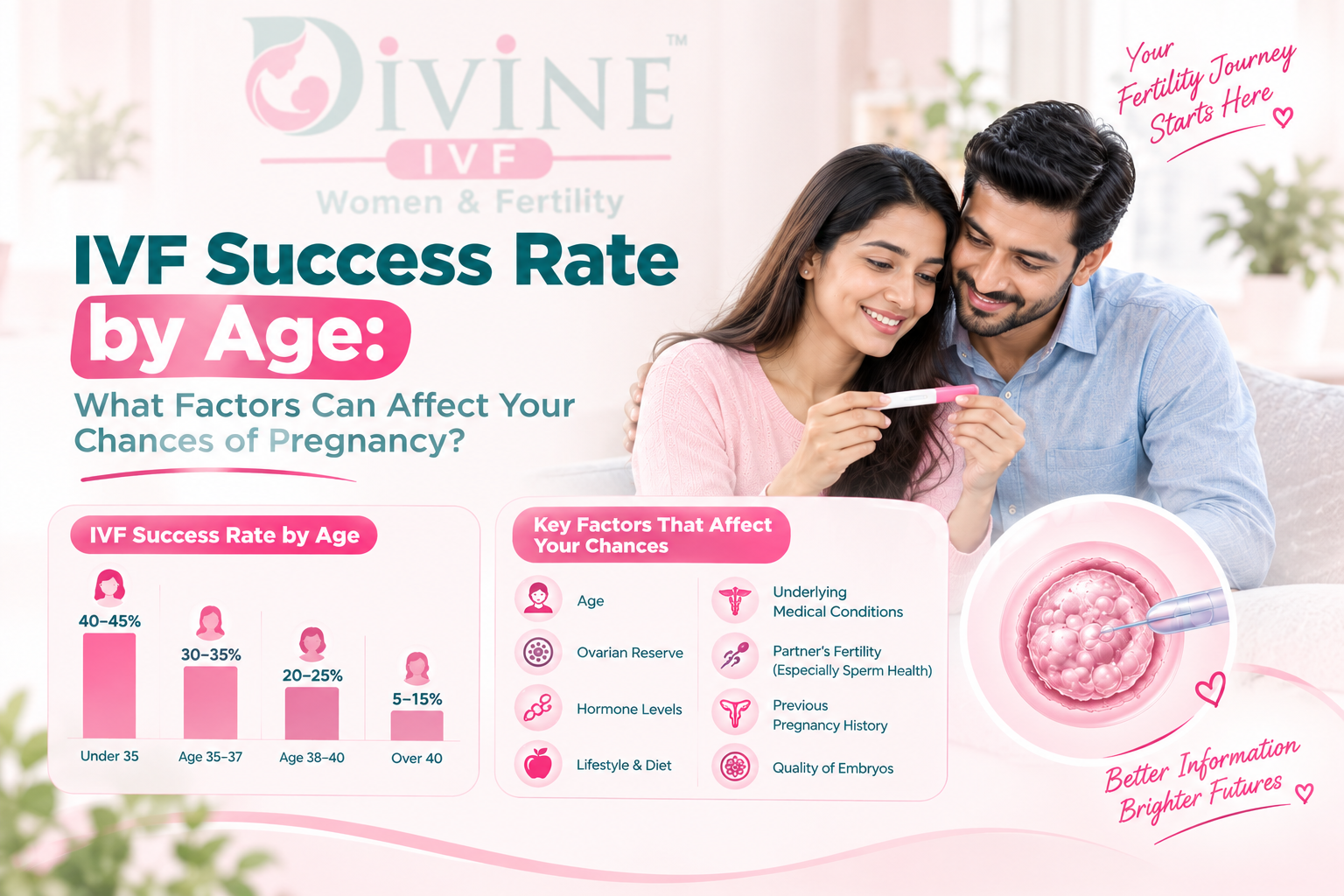
IVF success rates decline with age. According to data from Divine IVF, success rates for women under 30 stand at 78%. For women aged 35-40, that figure drops to 58%. These are still meaningful numbers — but they illustrate a pattern that cannot be ignored.
More importantly, the options available to you may change. A woman with diminished ovarian reserve at 32 may still be able to use her own eggs. At 40, the same condition may make donor eggs the more realistic path.
Waiting does not improve fertility. It only narrows the choices.
Frequently Asked Questions (FAQ)
How do I know if I need an IVF specialist?
You should consider seeing an IVF specialist if you have been trying to conceive for 12 months (or 6 months if over 35), have irregular periods, experience severe pelvic pain, have had multiple miscarriages, or carry a diagnosis like PCOS or endometriosis. A fertility specialist can provide a proper diagnosis and personalised treatment plan.
At what age should I see a fertility specialist?
Women over 35 should see a specialist after 6 months of trying. Women over 40 should consult immediately. If you have a known fertility-related condition or concerning symptoms, age alone should not delay your consultation.
Can I see an IVF specialist if I am not ready for IVF?
Absolutely. A fertility specialist consultation is about diagnosis and information, not immediate treatment. Many couples leave with a clearer understanding of their fertility and options that do not involve IVF. The goal is to help you make informed decisions.
Does my partner need to be evaluated too?
Yes. Male factor infertility contributes to 40-50% of infertility cases. A complete fertility evaluation includes semen analysis for the male partner. This is standard practice and not a reflection of blame — it is simply good medicine.
How long does a fertility consultation take?
A first consultation typically takes 30-45 minutes. It includes a detailed history, review of any previous tests, and discussion of recommended investigations. You will have time to ask questions and understand the next steps.
What tests will be done at the first visit?
For women: blood tests for hormone levels (FSH, LH, AMH, thyroid, prolactin) and an ultrasound to assess ovarian reserve and uterine health. For men: semen analysis. Additional tests like HSG (to check fallopian tubes) may be recommended based on your history.
Is IVF the only option if I see an IVF specialist?
No. Fertility specialists offer a range of treatments — ovulation induction, IUI, IVF, ICSI, and more. The right treatment depends on your diagnosis, age, and preferences. IVF is one tool among many.
Conclusion: Your Next Step Can Start With a Conversation
If you have read this far, something brought you here. Maybe it is one of the seven signs. Maybe it is simply a feeling that you need answers.
You do not have to navigate this alone.
At Divine IVF in Sector 76, Noida, Dr. Mandavi Rai and her team provide personalised, ethical fertility care grounded in 15+ years of experience and over 3,000 parenthood journeys. Whether you need a basic fertility assessment, advanced IVF treatment, or simply a conversation about your options, the first step is reaching out.
Book your consultation today and take the first step toward a clear, personalised plan.