
Hysteroscopy in Noida A closer look inside the uterus for selected fertility and gynaecological concerns
Hysteroscopy is a minimally invasive procedure that allows a gynaecologist to directly examine the inside of the uterus using a thin camera called a hysteroscope.
What is Hysteroscopy?
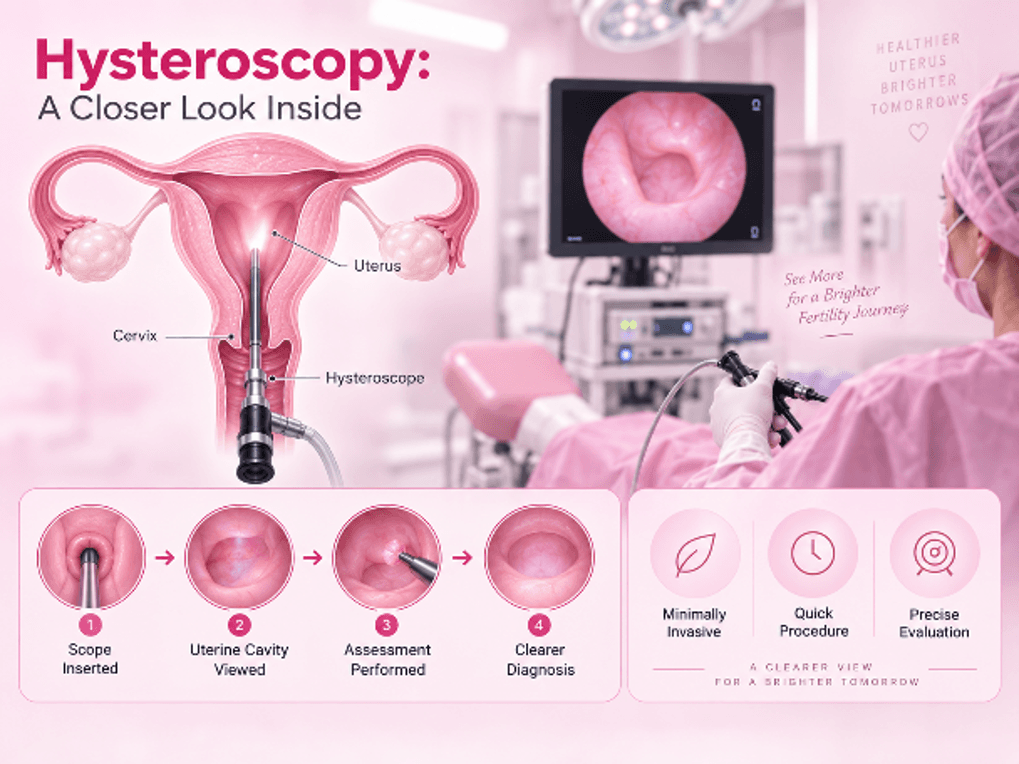
Hysteroscopy is a procedure used to examine the inside of the uterus. A thin, lighted telescope-like device called a hysteroscope is passed through the vagina, the cervix, and into the uterine cavity. No abdominal incision is required.
The hysteroscope allows the doctor to directly inspect the uterine lining and cavity. Depending on the indication, hysteroscopy can be diagnostic (to look inside the uterus and identify abnormalities) or operative (when treatment is performed through the hysteroscope).
At Divine IVF, Sector 76, Noida, Dr. Mandavi Rai provides personalised gynaecological and fertility assessment to determine whether hysteroscopy is clinically indicated. Not every infertility patient requires hysteroscopy. Less-invasive investigations are often used first unless there is a specific reason to directly examine or treat the uterine cavity.
How it works
Step 1 – Consultation and Evaluation
Before hysteroscopy, the doctor reviews symptoms, fertility history, menstrual history, ultrasound findings, previous surgery, pregnancy history, and current medicines.
Step 2 – Timing of the Procedure
Hysteroscopy is usually planned when the uterine lining can be assessed clearly. The timing depends on the menstrual cycle, clinical indication, pregnancy possibility, and procedure type.
Step 3 – Pain Relief or Anaesthesia
Depending on whether hysteroscopy is diagnostic or operative, pain-management options may include oral medication, local anaesthesia, sedation, or general anaesthesia. Not every hysteroscopy requires general anaesthesia.
Step 4 – Hysteroscope Insertion
The hysteroscope is passed through the vagina and cervix into the uterus. No abdominal incision is needed.
Step 5 – Uterine Cavity Expansion
Fluid, commonly saline, may be introduced into the uterine cavity. This gently expands the cavity so the lining and internal structures can be seen more clearly.
Step 6 – Direct Examination
The doctor examines the uterine lining, cavity shape, polyps, fibroids, adhesions, and other abnormalities.
Step 7 – Treatment if Required
If operative hysteroscopy is planned, small instruments may be passed through the hysteroscope to remove polyps, treat selected fibroids, divide adhesions, obtain tissue samples, or treat certain structural abnormalities.
Step 8 – Completion and Recovery
After the procedure, the hysteroscope is removed. Many patients can return home the same day, depending on the procedure and anaesthesia used.
Benefits
- Direct visual assessment of the uterine cavity — the most accurate way to evaluate uterine health
- Can combine diagnosis and treatment in a single procedure — no need for a second procedure
- Minimally invasive — no incisions, performed through the natural opening of the cervix
- A valuable step in fertility investigation for suitable cases, especially recurrent implantation failure
- Can remove polyps, fibroids, and adhesions that may be affecting fertility or causing symptoms
- Provides definitive diagnosis of uterine abnormalities that may not be visible on ultrasound
- Quick recovery compared to more invasive surgical procedures
Things to know
- As with any procedure, involves standard procedural risks that Dr. Rai will explain beforehand — including bleeding, infection, and perforation (rare)
- Some findings may require a separate, more extensive follow-up procedure if they can't be treated during the initial hysteroscopy
- Timing within your cycle may affect scheduling — diagnostic hysteroscopy is typically performed in the proliferative phase
- Mild cramping and spotting are common afterward — normal activities can usually resume within 1-2 days
- Operative hysteroscopy may require sedation or anaesthesia, with associated considerations
- Not all uterine conditions can be treated through hysteroscopy — some may require alternative approaches
Getting ready
Before hysteroscopy, the doctor reviews symptoms, fertility history, menstrual history, ultrasound findings, previous surgery, pregnancy history, and current medicines.
Hysteroscopy is usually planned when the uterine lining can be assessed clearly. The timing depends on the menstrual cycle, clinical indication, pregnancy possibility, and procedure type.
Diagnostic hysteroscopy is often scheduled for a specific point in your cycle, usually shortly after your period ends (days 5-10), when the uterine lining is thinnest and easiest to assess.
If operative hysteroscopy with sedation or anaesthesia is planned, you'll be given fasting instructions beforehand (typically no food or drink after midnight) and should arrange for someone to accompany you home afterward.
What to expect
Diagnostic hysteroscopy is often a quick outpatient procedure lasting about 5-15 minutes. It's usually well-tolerated with mild cramping similar to period pain. Operative hysteroscopy may take longer (20-60 minutes or more depending on complexity) and, depending on the extent of treatment, may involve sedation or general anaesthesia. Mild cramping and light spotting afterward are common for a few days. Most patients can return to normal activity within a day or two, though this depends on what was found and treated.
Hysteroscopy in Noida
A closer look inside the uterus for selected fertility and gynaecological concerns at Divine IVF, Sector 76, Noida.
📍 Sector 76, Noida, Uttar Pradesh
📞 Call: +91 7678451808

What Is Hysteroscopy?
Hysteroscopy is a procedure used to examine the inside of the uterus.
A thin, lighted telescope-like device called a hysteroscope is passed through:
- The vagina
- The cervix
- Into the uterine cavity
No abdominal incision is required.
The hysteroscope allows the doctor to directly inspect the uterine lining and cavity.
Depending on the indication, hysteroscopy can be:
- Diagnostic — performed mainly to look inside the uterus and identify abnormalities
- Operative — used when treatment is performed through the hysteroscope
Why Is Hysteroscopy Done?
Hysteroscopy may be used to investigate or treat conditions such as:
Hysteroscopy allows direct visualisation of the uterine cavity and, in many cases, treatment can be performed during the same procedure.
Diagnostic Hysteroscopy vs Operative Hysteroscopy
Diagnostic Hysteroscopy
Performed mainly to look inside the uterus and identify abnormalities. It may help evaluate:
- Uterine cavity shape
- Polyps
- Fibroids projecting into the cavity
- Adhesions
- Septum
- Causes of abnormal bleeding
- Selected recurrent miscarriage concerns
Operative Hysteroscopy
Used when treatment is performed through the hysteroscope. Depending on the condition, this may involve:
- Polyp removal
- Removal of selected submucosal fibroids
- Division of adhesions
- Correction of certain uterine septa
- Removal of retained tissue
- Biopsy
The exact treatment depends on the diagnosis.



Hysteroscopy and Fertility
Is Hysteroscopy Used for Infertility?
Yes, but it is not required for every infertility patient.
Hysteroscopy can identify abnormalities inside the uterine cavity that may interfere with implantation, pregnancy, or embryo transfer. Possible findings include polyps, submucosal fibroids, adhesions, and septum.
However, fertility evaluation often begins with less-invasive investigations such as ultrasound or saline sonography. Hysteroscopy is usually considered when there is a specific indication or an abnormal uterine finding.
Hysteroscopy Before IVF
Hysteroscopy is not routinely required before every IVF cycle.
It may be considered when there is:
The decision should depend on whether hysteroscopy is likely to change the fertility treatment plan.
Hysteroscopy in Specific Situations
Hysteroscopy After Failed IVF
A failed IVF cycle does not automatically mean there is a uterine cavity problem.
Before recommending hysteroscopy, the fertility specialist may review:
If a cavity abnormality is suspected, hysteroscopy may be useful.
Hysteroscopy for Endometrial Polyps
Endometrial polyps are growths arising from the lining of the uterus. They may be associated with irregular bleeding, heavy bleeding, bleeding between periods, and fertility concerns. During hysteroscopy, a polyp can be visualised directly and may be removed during the same procedure.
Hysteroscopy for Fibroids
Fibroids are benign growths arising from the uterine muscle. Not every fibroid can be treated through hysteroscopy. Hysteroscopic treatment is mainly relevant to submucosal fibroids that project into the uterine cavity. The suitability of hysteroscopic removal depends on fibroid size, location, depth within the uterine wall, symptoms, and fertility goals.
Hysteroscopy for Intrauterine Adhesions
Intrauterine adhesions are bands of scar tissue inside the uterine cavity. They may develop after uterine surgery, infection, pregnancy-related procedures, or previous instrumentation. Symptoms may include reduced menstrual flow, absent periods, infertility, and recurrent pregnancy loss. Hysteroscopy is an important method for directly identifying and treating adhesions.
Special Uterine Conditions
What Is Asherman Syndrome?
Asherman syndrome refers to significant intrauterine adhesions or scar tissue. It may affect menstrual flow, fertility, implantation, and pregnancy. Hysteroscopy can be used to diagnose and, in selected cases, divide the adhesions.
Hysteroscopy for Uterine Septum
A uterine septum is a congenital abnormality in which a band of tissue partially or completely divides the uterine cavity. In selected cases, hysteroscopy may be used to evaluate and treat a septum. The decision depends on reproductive history, pregnancy-loss history, imaging, and septum anatomy.
Hysteroscopy for Other Gynaecological Conditions
Hysteroscopy for Recurrent Pregnancy Loss
Certain uterine abnormalities may contribute to recurrent pregnancy loss. These can include septum, adhesions, cavity-distorting fibroids, and polyps in selected cases. Hysteroscopy may therefore be part of the evaluation when uterine pathology is suspected. It should be used as part of a complete recurrent pregnancy-loss assessment rather than as the only investigation.
Hysteroscopy for Abnormal Uterine Bleeding
Hysteroscopy may be useful when a woman experiences heavy periods, prolonged bleeding, bleeding between periods, bleeding after menopause, or unexplained abnormal uterine bleeding. It can allow direct assessment of the uterine lining and removal or biopsy of selected abnormalities.
Hysteroscopy and Endometrial Biopsy
During hysteroscopy, a tissue sample may be taken from the uterine lining when clinically indicated. The sample can then be examined in a laboratory. Biopsy may be recommended in selected cases involving abnormal bleeding, suspicious endometrial findings, or other clinically relevant concerns.
Pain, Recovery, and Risks
Is Hysteroscopy Painful?
The experience varies. Some patients undergoing office diagnostic hysteroscopy may experience period-like cramps, pressure, or temporary discomfort. More extensive procedures may require stronger pain relief or anaesthesia. You should discuss pain-management options before the procedure.
Recovery After Hysteroscopy
After hysteroscopy, patients may experience mild cramping, light spotting, watery discharge, and temporary tiredness. For many patients undergoing minor hysteroscopy, normal activities can often be resumed relatively quickly. Recovery may take longer after operative procedures.
When Can I Return to Work After Hysteroscopy?
Many patients undergoing a simple diagnostic procedure can return to normal activities by the next day. More extensive operative hysteroscopy may require additional recovery time. Your doctor will provide advice based on procedure type, anaesthesia, treatment performed, and individual recovery.
Risks of Hysteroscopy
Hysteroscopy is generally considered a safe procedure, but complications can occur. Possible risks include bleeding, infection, cervical injury, uterine perforation, fluid-related complications, anaesthesia-related risks, and rare need for additional surgery. Operative hysteroscopy generally carries a higher complication risk than simple diagnostic hysteroscopy.
Warning Signs After Hysteroscopy
Contact your doctor if you develop:
These symptoms may require medical assessment.
Hysteroscopy vs Other Investigations
Hysteroscopy vs Laparoscopy
These procedures examine different parts of the reproductive system. Hysteroscopy examines the inside of the uterus through the vagina and cervix and is useful for polyps, cavity fibroids, adhesions, and septum. Laparoscopy examines the outside of the uterus and the pelvic organs through small abdominal incisions and may be useful for endometriosis, pelvic adhesions, ovarian cysts, and tubal abnormalities. Some fertility patients may require one procedure, while others may need neither or, rarely, both.
Hysteroscopy vs Ultrasound
Ultrasound is non-invasive and is commonly used first to assess the uterus, endometrium, fibroids, ovaries, and pelvic anatomy. Hysteroscopy provides direct visualisation of the uterine cavity and also allows certain problems to be treated during the same procedure. For this reason, hysteroscopy is considered the definitive method for diagnosing and treating many intrauterine abnormalities.
Hysteroscopy vs HSG
HSG (Hysterosalpingography) is an X-ray-based test mainly used to assess the uterine cavity shape and fallopian tube patency. Hysteroscopy directly visualises the uterine cavity but does not routinely assess the full length of the fallopian tubes. These tests answer different fertility questions.
Hysteroscopy vs Saline Sonography
Saline sonography can provide detailed imaging of the uterine cavity without surgery. It may help identify polyps, submucosal fibroids, and adhesions. Hysteroscopy allows direct visualisation and can also allow treatment if a problem is identified.
Can Hysteroscopy Improve Fertility?
If hysteroscopy identifies and successfully treats a uterine cavity abnormality that is affecting fertility, it may improve the reproductive environment.
However, hysteroscopy does not guarantee:
Fertility outcomes also depend on:
Hysteroscopy and Embryo Transfer
A normal uterine cavity can be important for embryo implantation. If hysteroscopy identifies a treatable cavity abnormality, treatment may be completed before embryo transfer. The timing of future IVF or frozen embryo transfer depends on the procedure performed, endometrial healing, fertility plan, and doctor`s recommendation.
Hysteroscopy Cost in Noida
The cost of hysteroscopy in Noida depends on the type of procedure. Cost may vary according to:
An accurate estimate should be provided after determining what procedure is actually required.
Questions to Ask Before Hysteroscopy
Before undergoing hysteroscopy, consider asking:
Why Choose Divine IVF for Hysteroscopy Assessment
- ✓Fertility-Focused Uterine Evaluation — The uterine cavity is evaluated with fertility and future pregnancy goals in mind.
- ✓Personalised Assessment — Hysteroscopy is considered based on symptoms, imaging and reproductive history rather than routinely for every patient.
- ✓Diagnostic and Operative Planning — Selected intrauterine abnormalities may be diagnosed and treated hysteroscopically where clinically appropriate.
- ✓Evaluation Before IVF or Embryo Transfer — Patients with suspected cavity abnormalities can be assessed before fertility treatment.
- ✓Gynaecological and Fertility Care — Uterine conditions can be managed within a broader fertility-treatment plan.
- ✓Care Under Dr. Mandavi Rai — Evaluation and fertility treatment planning are provided under the guidance of Dr. Mandavi Rai, Gynecologist & IVF Specialist in Noida.
- ✓Convenient Location in Sector 76, Noida — Divine IVF is located in Sector 76, Noida, for patients seeking gynaecological and fertility assessment in Noida.
Book a Hysteroscopy Consultation in Noida
If you have abnormal bleeding, suspected uterine polyps or fibroids, recurrent pregnancy loss, intrauterine adhesions, or fertility concerns involving the uterine cavity, a detailed consultation can help determine whether hysteroscopy is appropriate. At Divine IVF, Sector 76, Noida, Dr. Mandavi Rai provides personalised gynaecological and fertility evaluation according to your symptoms, imaging and reproductive history.
Divine IVF · Sector 76, Noida, Uttar Pradesh
Resources
Common questions
Hysteroscopy is a procedure in which a thin camera is passed through the vagina and cervix to examine the inside of the uterus.
Diagnostic hysteroscopy is a minimally invasive procedure. Operative hysteroscopy may involve surgical treatment inside the uterine cavity.
No.
It may identify uterine abnormalities such as polyps, submucosal fibroids, adhesions or septum that could affect implantation or pregnancy.
No. It is usually considered only when there is a specific clinical indication.
Yes, selected uterine polyps can often be removed hysteroscopically.
Selected submucosal fibroids projecting into the uterine cavity may be treated through hysteroscopy.
Yes. Intrauterine adhesions may be divided hysteroscopically in selected cases.
It may be useful when a uterine cavity abnormality is suspected as part of recurrent pregnancy-loss evaluation.
Some patients experience cramping or discomfort. Pain-relief options depend on whether the procedure is diagnostic or operative.
Not always. Some diagnostic procedures can be performed with minimal pain relief, while operative hysteroscopy may require sedation or general anaesthesia.
Recovery is usually short after diagnostic hysteroscopy. Operative procedures may require more recovery time.
Many hysteroscopies are day-care procedures.
It may help if a treatable uterine cavity abnormality is present, but hysteroscopy itself does not guarantee IVF success.
Cost varies depending on whether the procedure is diagnostic or operative and whether treatment such as polyp, fibroid or adhesion removal is required.
You can consult Dr. Mandavi Rai at Divine IVF, Sector 76, Noida for personalised uterine, gynaecological and fertility evaluation.
Ready to talk to Dr. Mandavi Rai?
Bring your questions, your history, and your pace — we`ll build the next step together.